
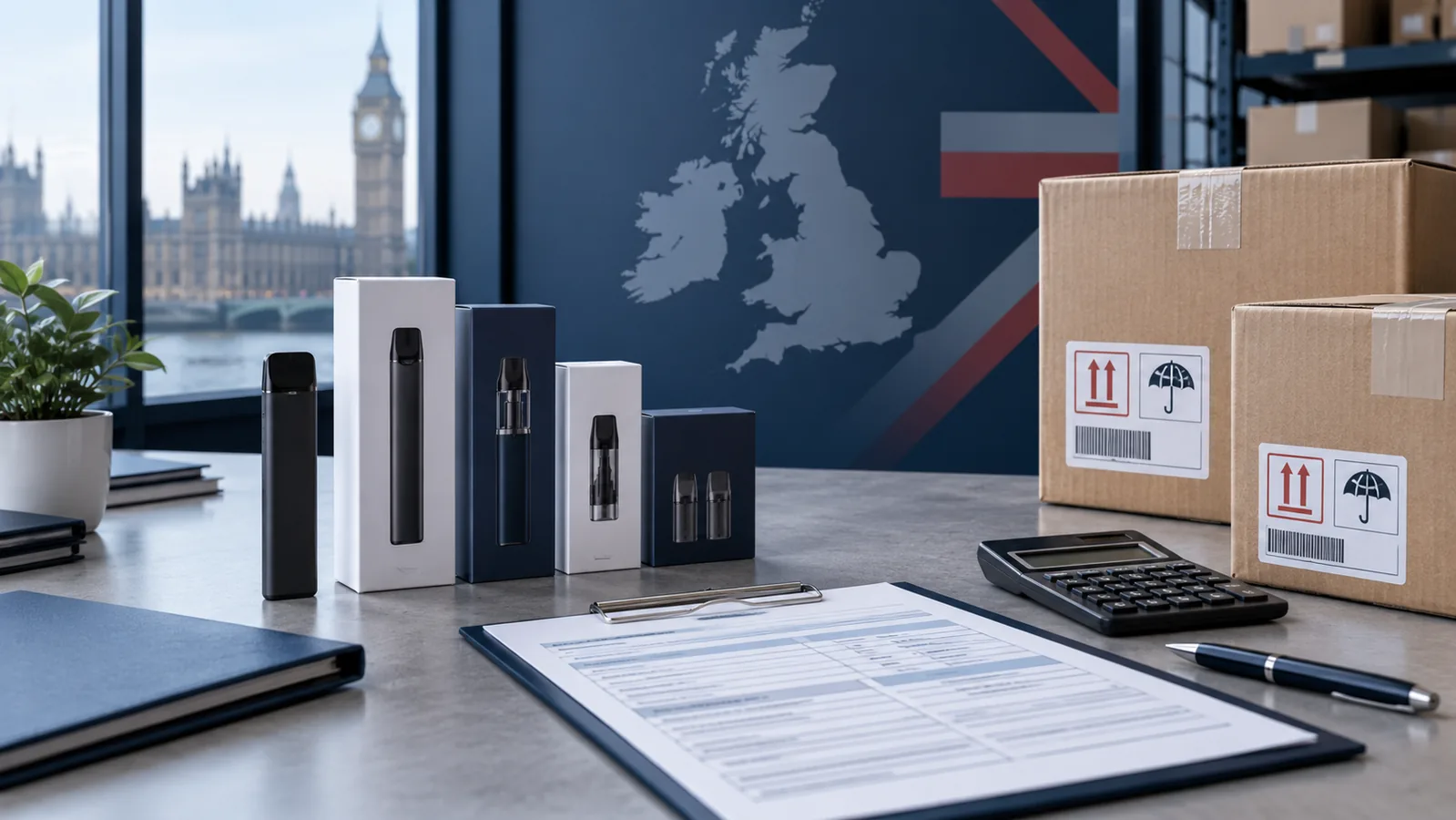
The United Kingdom introduced its new Vaping Products Duty and Vaping Duty Stamps Scheme on 1 October 2026. For vape importers, wholesalers, distributors and retailers, the change affects far more than tax calculations. Product packaging, shipment timing, SKU records, supplier checks and landed-cost models now need to work together before stock is released onto the UK market.
This article summarises the official HM Revenue & Customs (HMRC) rules published at the start of the new regime and translates them into practical procurement questions. It is general commercial information, not legal or tax advice. Importers should confirm the latest requirements with HMRC and qualified advisers before placing or releasing an order.
Fact Summary
- The Vaping Products Duty took effect on 1 October 2026.
- The rate is £2.20 per 10 ml of vaping liquid, equivalent to £0.22 per ml.
- The duty applies to vaping liquids manufactured in or imported into the UK, whether or not they contain nicotine, unless the goods are held under an approved duty-suspension arrangement.
- Products released for UK consumption from 1 October 2026 generally need a vaping duty stamp on the outermost retail packaging.
- Transitional stamps can be used for eligible products until 31 December 2026; digital-functionality stamps become mandatory for new products manufactured in or imported into the UK from 1 January 2027.
What Changed on 1 October 2026?
HMRC states that Vaping Products Duty applies to all vaping liquids manufactured in or imported into the UK from 1 October 2026, including zero-nicotine liquids. The duty is calculated by liquid volume, not by nicotine strength or the advertised puff count.
This distinction matters for purchasing teams. Two devices with similar positioning may carry different duty exposure if their liquid volumes differ. A buyer comparing products only by unit price or puff count may therefore underestimate the true landed cost.
The new duty-stamp scheme adds a packaging and traceability requirement. HMRC says products released onto the UK market from 1 October must carry the required stamp on the outermost retail packaging. Importers that arrange overseas stamping need an approved UK representative to purchase and manage stamps. Goods entering an approved customs or excise warehouse under duty suspension follow a different process, so the intended import route must be agreed before dispatch.
Who Needs to Pay Attention?
The immediate obligations vary by business activity. UK manufacturers, approved importers and warehousekeepers may have approval, reporting and duty-accounting responsibilities. A business that only buys and distributes duty-paid products wholesale or retail may not need the same approval, but HMRC still expects it to check the legitimacy of stock and maintain accessible commercial records.
For B2B buyers, the operational lesson is simple: clarify who is responsible for importing, stamping, paying duty, holding goods under suspension and releasing them for UK consumption. Avoid relying on a vague delivery term such as “door to door” without a written allocation of these roles.
Six Procurement Checks Before Confirming UK-Bound Stock
1. Capture Net Liquid Volume at SKU Level
Request the net liquid volume for every device, pod, refill or kit. HMRC guidance says customs declarations should use accurate product descriptions and include net liquid volume in litres. Keep the supporting specification, invoice, packing list and measurement evidence aligned.
Do not estimate duty from puff count. Use the declared liquid volume and verify any multi-pod or multi-tank configuration.
2. Rebuild the Landed-Cost Model
At £0.22 per ml, the duty contribution can materially change retail economics. For example, the duty on 2 ml of liquid is £0.44, while 10 ml produces £2.20 of duty. These figures exclude VAT, customs costs, logistics and other commercial expenses.
Update purchase comparisons at SKU level and stress-test margin after duty, VAT and channel costs. A cheaper ex-works price may not produce the best UK landed margin.
3. Confirm the Duty-Stamp Plan
Before production or shipment, establish whether the product will be stamped overseas or after entering an approved UK arrangement. Confirm which party manages the stamps, where they will be attached and how the packaging remains sealed.
The transition period also deserves attention. HMRC says transitional stamps can be affixed until 31 December 2026, while digital-functionality stamps become mandatory for new products manufactured in or imported from 1 January 2027. Buyers planning stock across the year-end change should coordinate packaging and shipment dates carefully.
4. Align Customs and Excise Instructions
If goods enter duty suspension, the customs declaration, warehouse route and movement records must agree. If goods are released at import, Vaping Products Duty is normally accounted for through the customs declaration.
Ask your customs broker and warehouse provider to confirm the intended procedure before the supplier books freight. Correcting a mismatch after arrival can delay release and increase storage costs.
5. Strengthen Supplier Due Diligence
HMRC advises wholesalers and retailers to check whether required stamps are present, where products came from, and whether the supplier can provide normal commercial documents such as invoices and delivery notes. The force-of-law notice also requires approved businesses to assess duty-fraud risk and retain appropriate records.
Your purchase file should connect the quotation, specification, artwork approval, invoice, packing list, transport documents, stamp arrangement and responsible UK entity. Resolve incomplete or inconsistent information before buying or selling the stock.
6. Separate UK Planning from EU Planning
The United Kingdom is not part of the EU customs and excise system. Stock held in an EU warehouse does not automatically satisfy UK Vaping Products Duty or duty-stamp requirements. A European fulfilment option may shorten delivery for eligible EU destinations, but a UK-bound order still needs its own import, tax and compliance plan.
How PaphosVape Supports B2B Sourcing
PaphosVape is a China-based vape wholesaler and supply-chain sourcing partner, not a manufacturer. We help overseas buyers compare product platforms, collect available specifications, coordinate quotations, consolidate orders and discuss documentation needs with relevant supply-chain partners.
Where private-label or OEM/ODM work is required, projects are coordinated through suitable licensed partner factories. Buyers remain responsible for verifying UK market-entry, tax, product-registration, packaging and retail requirements. PaphosVape does not issue HMRC approvals or replace UK legal, customs or tax advice.
For UK-bound enquiries, share the target product, liquid volume, quantity, packaging plan, destination and preferred import route. This information helps us request more useful quotations and identify questions that should be resolved before dispatch.
Practical Next Step for Buyers
Review every UK-bound SKU against one procurement sheet containing net liquid volume, unit cost, estimated duty, packaging version, stamp route, importer of record, warehouse procedure and document status. Do not release a purchase order until commercial, customs and stamp responsibilities are confirmed in writing.
Explore our China vape wholesale and sourcing role, review OEM/ODM sourcing through licensed partner factories, or request a wholesale quote with your target market and required product specifications.
Official Sources
- HMRC: New Vaping Products Duty comes into effect
- HMRC: Importing and exporting vaping products
- HMRC: How to pay Vaping Products Duty
- HMRC: Handling wholesale or retail vaping products in the UK
- HMRC: Vaping Products Duty and Vaping Duty Stamps Force of Law Notice
Frequently Asked Questions
When did the UK Vaping Products Duty start?
It took effect on 1 October 2026. HMRC says liable vaping liquids manufactured in or imported into the UK from that date are subject to the new regime unless an approved duty-suspension arrangement applies.
What is the UK Vaping Products Duty rate?
The rate is £2.20 per 10 ml of vaping liquid, equivalent to £0.22 per ml. It applies regardless of nicotine strength.
Do zero-nicotine vaping liquids fall within the duty?
Yes, HMRC states that vaping liquids can be liable whether or not they contain nicotine, subject to the legal definition and exclusions.
Do wholesalers and retailers need HMRC approval?
A business that only sells or distributes duty-paid products wholesale or retail may not need approval for the duty or stamp scheme. However, HMRC expects businesses to check stamps where required, keep records and resolve suspicious or inconsistent supply information.
Does EU warehouse stock automatically comply with UK rules?
No. EU warehousing and UK import compliance are separate. UK-bound stock must follow the applicable UK customs, duty, stamp and product rules.
Can PaphosVape guarantee UK compliance?
No. PaphosVape can coordinate sourcing information and available documents, but the UK importer and seller must verify current legal, tax and market-entry requirements with HMRC and qualified advisers.
Request Wholesale Quote: Tell PaphosVape your target products, quantities and destination. We normally reply within 24 hours on business days.